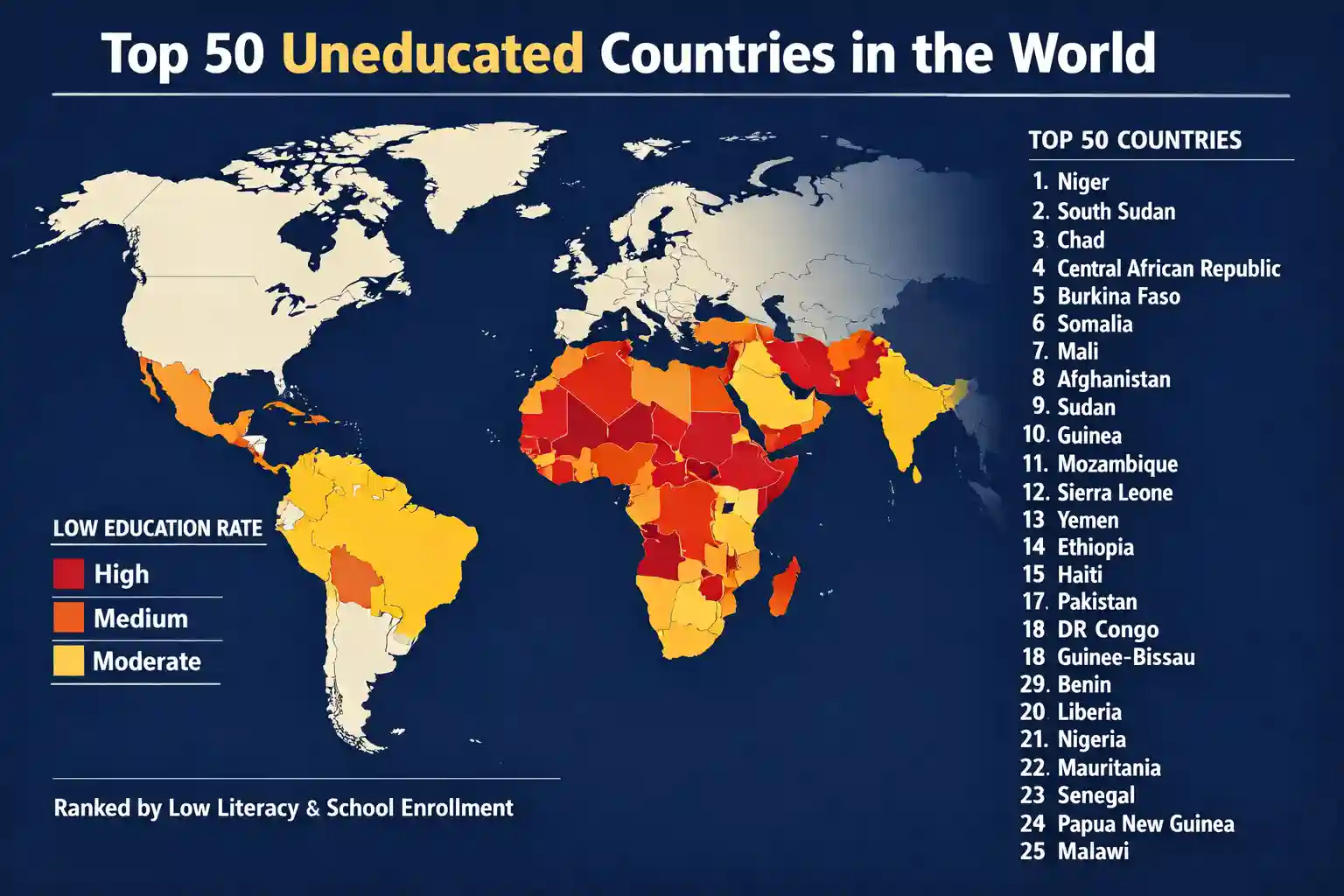
Education is one of the most important pillars of social and economic development. Countries with high literacy rates generally experience stronger economies, better healthcare outcomes, and improved quality of life. However, many regions across the world still struggle with limited access to education, resulting in large populations remaining uneducated.This article explores the Top 50 uneducated countries in the world, focusing primarily on literacy rates as a key indicator of education levels. While the term uneducated can sound harsh, it is used here in a statistical and educational context to describe countries where a significant portion of the population lacks basic reading and writing skills.
What Does “Uneducated” Mean in Global Education Rankings?
In global studies, uneducated countries are typically identified using measurable indicators such as:
- Adult literacy rate
- Youth literacy rate
- Average years of schooling
- Access to primary and secondary education
Among these, literacy rate is the most widely used metric. A country is often classified as less educated when a large percentage of adults cannot read or write a simple sentence.
Least Educated Countries in the World by Literacy Rate
Literacy is the foundation of education. Without basic reading and writing skills, individuals face difficulties in:
- Accessing employment
- Understanding health information
- Participating in civic life
- Escaping poverty
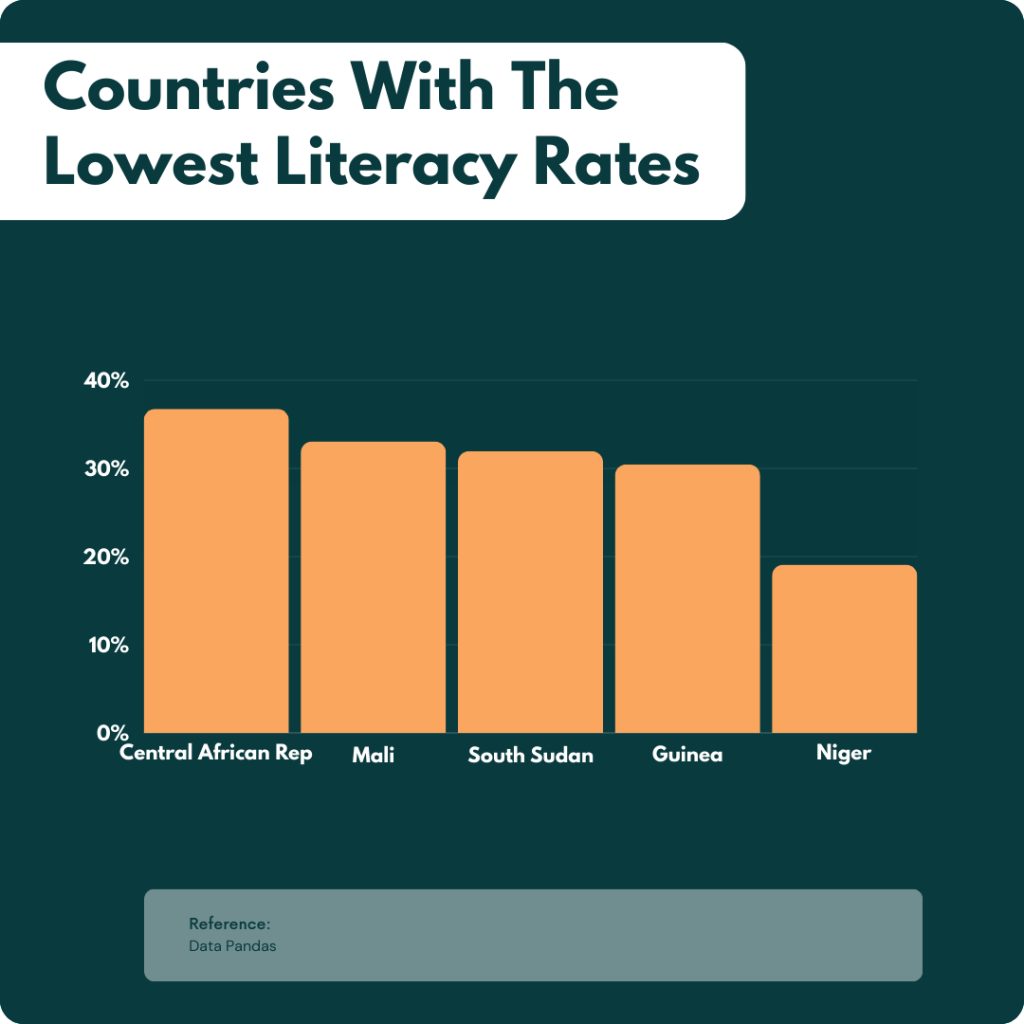
That is why literacy rates are used to rank uneducated countries globally. Nations with literacy rates below 70% are generally considered to face serious education challenges.
Global Education Rankings and Uneducated Nations
Most of the world’s least educated nations are concentrated in:
- Sub-Saharan Africa
- South Asia
- Conflict-affected regions of the Middle East
These regions face overlapping challenges such as poverty, war, political instability, and weak education systems.
Reasons Behind Low Education Levels in Some Countries
The following countries consistently rank at the bottom of global literacy indexes:
- Niger
- Chad
- Mali
- South Sudan
- Burkina Faso
- Afghanistan
- Central African Republic
- Somalia
- Guinea
- Sierra Leone
In these nations, adult literacy rates often fall below 40%, meaning more than half of the population is considered uneducated by global standards.
Literacy Rates in the Top 50 Uneducated Countries
Below is a broader list of countries frequently included among the top 50 uneducated countries due to low literacy and education access:
- Niger
- Chad
- Mali
- South Sudan
- Burkina Faso
- Afghanistan
- Central African Republic
- Somalia
- Guinea
- Sierra Leone
- Liberia
- Ethiopia
- Guinea-Bissau
- Yemen
- Benin
- Senegal
- Pakistan
- Sudan
- Haiti
- Papua New Guinea
- Nigeria
- Mozambique
- Togo
- Malawi
- Mauritania
- Djibouti
- Nepal
- Bhutan
- Angola
- Burundi
- Bangladesh
- Rwanda
- Morocco
- Eritrea
- Madagascar
- Cameroon
- Uganda
- Democratic Republic of the Congo
- Ghana
- Republic of the Congo
- Comoros
- Timor-Leste
- Egypt
- India
- Algeria
- Lesotho
- Solomon Islands
- Gambia
- Côte d’Ivoire
These countries face varying degrees of educational disadvantage, but all struggle with high proportions of Top 50 uneducated Countries in the world populations.
Challenges Faced by the Least Educated Countries
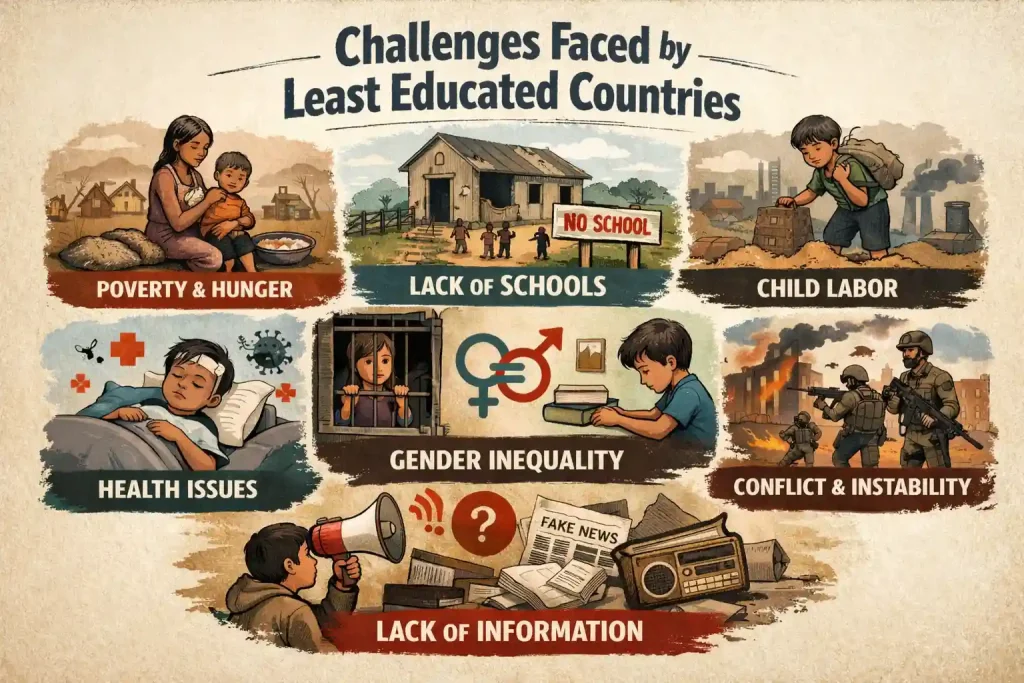
1. Poverty
Families living in poverty often prioritize survival over schooling. Children are forced to work instead of attending school.
2. Armed Conflict and War
War destroys schools, displaces families, and disrupts education systems, leaving generations uneducated.
3. Gender Inequality
In many uneducated countries, girls are less likely to attend school due to cultural norms and early marriage.
4. Poor Government Investment
Low education budgets lead to teacher shortages, overcrowded classrooms, and lack of learning materials.
5. Rural Isolation
Children in remote villages may live miles away from the nearest school, making attendance difficult.
How Education Reforms Can Improve Uneducated Nations
Countries with large uneducated populations face long-term challenges such as:
- High unemployment
- Low economic growth
- Increased crime rates
- Poor healthcare outcomes
- Political instability
Education is directly linked to national development, making illiteracy a major obstacle for progress.
Gender Gap in Education Across Uneducated Nations
In most uneducated countries, women make up the majority of illiterate adults. Cultural restrictions, early marriage, and lack of access to education disproportionately affect girls.
Improving female literacy is one of the fastest ways to reduce poverty and improve national education statistics.
International Aid for Education in Uneducated Countries
Several global organizations work to reduce illiteracy in uneducated countries, including:
- UNESCO
- UNICEF
- World Bank
- Non-governmental organizations (NGOs)
Their initiatives focus on building schools, training teachers, and promoting inclusive education policies.
Access to Schools in Uneducated Countries
Despite challenges, progress is being made. Many uneducated countries have seen gradual improvements in:
- Primary school enrollment
- Youth literacy rates
- Girls’ education access
However, population growth often outpaces education expansion, making progress slow.
How Education Reforms Can Improve Uneducated Nations
When literacy improves, countries experience:
- Higher incomes
- Better healthcare awareness
- Reduced child mortality
- Stronger democratic participation
Education empowers individuals and strengthens entire societies.
Challenges in Measuring Uneducated Populations
Accurate data collection is difficult in conflict zones and rural areas. As a result, literacy figures for uneducated countries may vary depending on the source and year.
Conclusion
The top 50 uneducated countries in the world face serious challenges related to literacy, poverty, and access to education. While the term uneducated reflects statistical realities rather than individual potential, it highlights the urgent need for global action.
Improving literacy rates is not just an educational goal—it is a humanitarian necessity. With sustained investment, policy reform, and international cooperation, even the most uneducated countries can build a more educated and prosperous future.